
Mold Inspection and Testing in Lakewood
24/7 mold inspection and testing in Lakewood and surrounding areas. IICRC-certified, insurance billing accepted. Call (253) 200-0503.
A musty smell in the basement that comes and goes with the weather. A faint ring on the drywall near a window that never seems to dry out. A tenant complaining of headaches in a unit with no visible damage at all. These are the moments that call for mold inspection and testing, not remediation, because you don’t yet know if there’s a problem worth remediating, or how big it is. Testing turns a guess into a number, and a number is what lets you make a decision instead of just worrying about one.
What mold inspection and testing actually involves
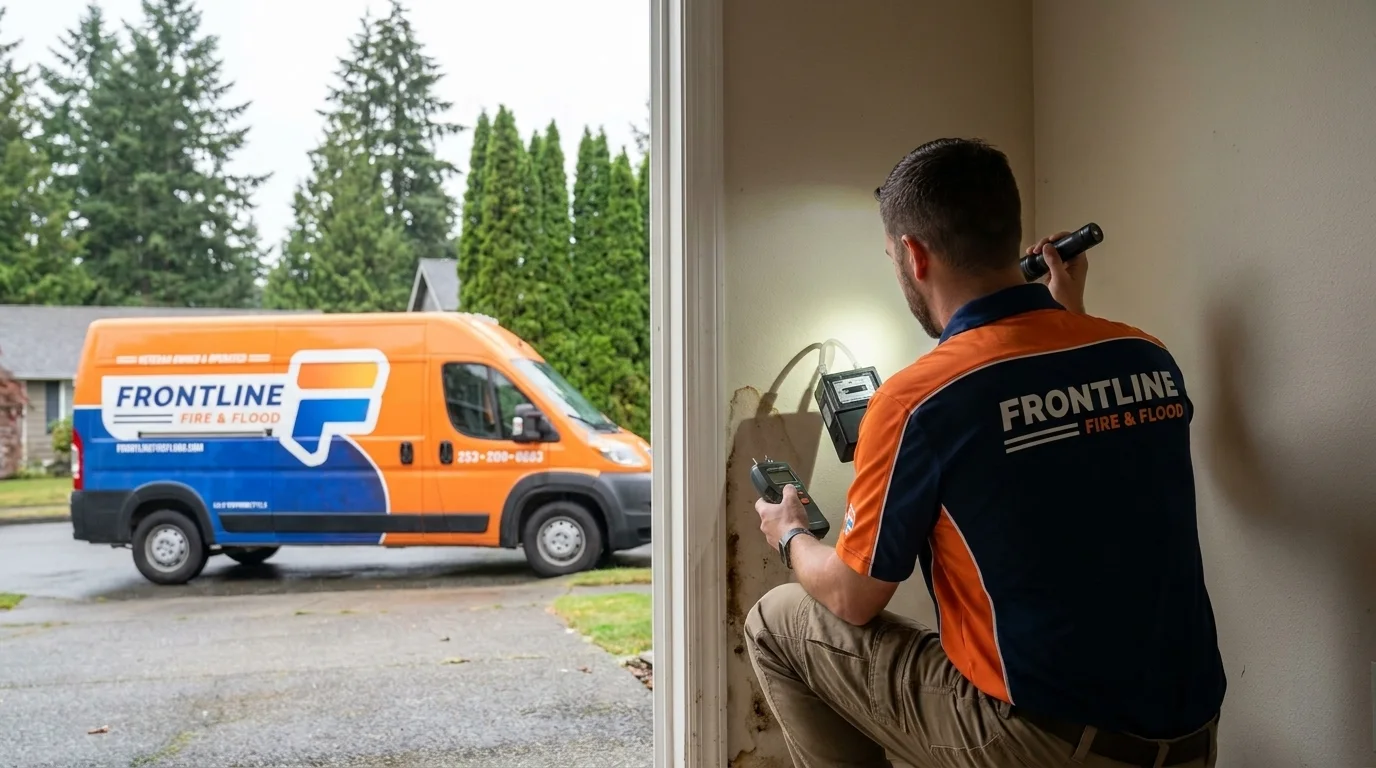
A mold assessment starts with a visual and moisture-driven inspection of the property: moisture meters on walls, floors, and framing; a thermal imaging scan where it’s useful for spotting hidden damp pockets behind finished surfaces; and a walk of any area with a known water history, past leak, or musty complaint. From there, air sampling and sometimes surface (tape-lift or swab) sampling are collected to measure spore counts and identify genus. Samples go to a third-party accredited lab, not an in-house one, because an inspector who tests his own remediation work has an obvious conflict of interest. Lab turnaround is typically a few business days, and the report compares indoor spore counts and species against an outdoor control sample, which is the baseline for judging whether indoor air is actually elevated.
Our process
- Intake and history review. We ask about past leaks, flooding, HVAC issues, and where occupants notice odors or symptoms, since mold almost always has a moisture story behind it.
- Visual inspection and moisture mapping. Moisture meters and, where helpful, thermal imaging identify damp building materials that may not show visible staining yet.
- Sample collection. Air samples are taken in suspect rooms and at least one outdoor control location; surface samples are collected from any visible growth or suspicious staining.
- Independent lab analysis. Samples go to a third-party laboratory for spore count and species identification, keeping the testing separate from any remediation recommendation.
- Written report and scope. You receive a report comparing indoor to outdoor spore counts, identifies any elevated genus, and, if remediation is warranted, a scope of work defining containment level under IICRC S520.
What separates a good mold inspection from a bad one
The most common shortcut is skipping the outdoor control sample, which makes an indoor spore count impossible to interpret correctly, since some mold spores are naturally present in outdoor air everywhere. Another is testing only the room where mold is visible and ignoring adjacent cavities, crawlspaces, or HVAC returns that may be circulating spores through the building. A good inspection also distinguishes between surface mold that’s a cleaning issue and active moisture intrusion that will keep feeding regrowth no matter how many times the surface gets wiped down, because testing without addressing the moisture source just buys time.
Insurance adjusters reviewing a mold claim typically want documentation tying the mold to a specific covered water event, photographs of the affected materials, moisture readings at the time of inspection, and lab results that establish the extent of contamination. An inspection report that’s vague about the moisture source, or that recommends remediation without defining a containment level, tends to get pushed back by carriers and slows down the claim.
What does mold inspection and testing cost?
Costs vary with the size of the property, the number of sample locations, and whether air sampling, surface sampling, or both are needed. Most homeowners pay more for a full-property assessment with multiple air samples than for a single-room visual inspection with one or two surface swabs. Every property and loss history is different, and Frontline Fire & Flood provides a written scope before any sampling or testing begins so there are no surprises on the invoice.
| Scenario | Typical range |
|---|---|
| Single room visual inspection, no sampling | $150 - $350 |
| Single room with air and surface sampling | $300 - $650 |
| Whole-house inspection with multiple air samples | $600 - $1,200 |
| Pre-purchase or real estate mold assessment | $300 - $700 |
| Post-remediation clearance testing | $250 - $600 |
Homeowners insurance typically covers mold testing when the mold is directly tied to a sudden, covered water event, such as a burst pipe, but most policies exclude mold resulting from long-term neglect, humidity, or a known unresolved leak. Documentation from the inspection and lab report is usually what the carrier needs to make that determination either way.
Seasonal & regional considerations
Lakewood’s wet fall and winter months, combined with the Puget Sound region’s persistent humidity, create long windows where building materials stay damp enough to support mold growth, especially in crawlspaces and daylight basements common in the area’s housing stock. Homes built before modern vapor barrier standards are particularly prone to crawlspace moisture that never fully dries between rain events. Spring, when the ground is still saturated but temperatures start to rise, is a common time for spore counts to spike indoors as dormant growth becomes active again.
Service area
Frontline Fire & Flood performs mold inspection and testing throughout Lakewood and the surrounding South Sound communities, including homes and commercial buildings with the crawlspace and basement conditions typical of the region’s older housing stock.
If something in your home smells off or a past leak has you wondering what’s growing behind the wall, request an air quality test and get a lab-backed answer before deciding on next steps. Call (253) 200-0503 to schedule an inspection.
Frequently Asked Questions
Does homeowners insurance cover mold inspection and testing?
What's the difference between air sampling and surface sampling?
Why do you send samples to an outside lab instead of testing in-house?
How long does mold inspection and lab testing take?
Do I need a mold inspection before buying or selling a house?
Looking for the best mold-inspection-testing company in Lakewood?
Frontline Fire & Flood provides licensed and insured mold-inspection-testing in Lakewood, WA and the surrounding area, and has served local property owners since 2014. Customers rate us 4.9 out of 5 stars across 137 Google reviews. We answer calls 24/7 — call (253) 200-0503 for immediate help.
Need mold-inspection-testing now?
We respond 24/7 across Lakewood and surrounding WA cities.
Related Coverage
- Our Restoration Services
- Contact Frontline Fire & Flood
- Restoration Services in Anderson Island
- Restoration Services in Auburn
- Restoration Services in Bonney Lake
- Restoration Services in Bremerton
- Restoration Services in Burien
- Restoration Services in Centralia
- Restoration Services in DuPont
- Restoration Services in Federal Way
- Restoration Services in Fife
- Restoration Services in Fircrest
- How To Test for Mold in Your Home (DIY Kits vs a Pro Inspection)