
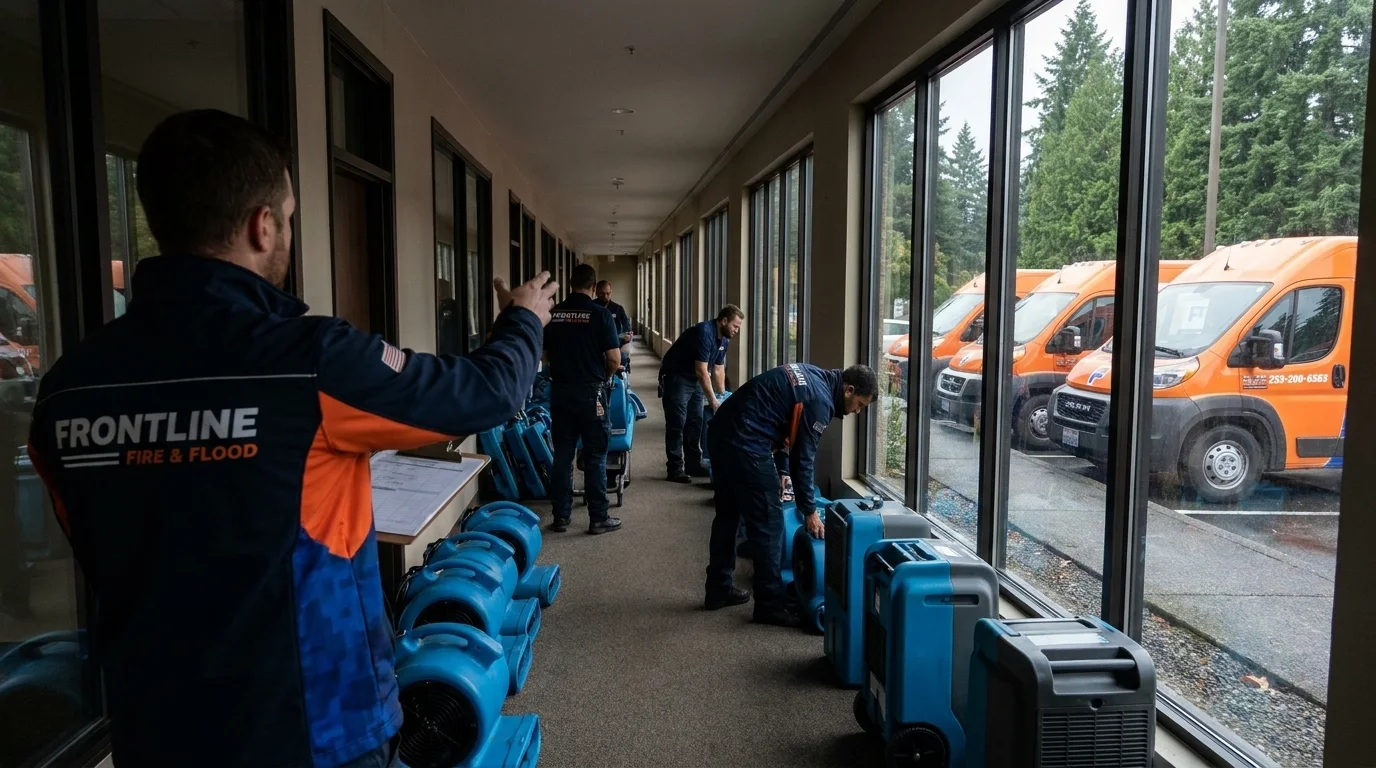
Large Loss and Catastrophic Response in Lakewood
24/7 large loss and catastrophic response in Lakewood and surrounding areas. IICRC-certified, insurance billing accepted. Call (253) 200-0503.
Large loss and catastrophic response is what happens when a single-room water job turns into a five-story apartment complex, when a warehouse fire takes out 40,000 square feet of inventory and structure, or when a storm event damages a dozen commercial properties in the same afternoon. These losses do not follow the timeline or staffing model of a typical residential claim. They require simultaneous crews, a general contractor’s license, direct coordination with large loss adjusters, and someone on-site who can run a multi-phase project without losing control of documentation. Frontline Fire & Flood is based in Lakewood and answers 24/7 for exactly this kind of job.
What large loss and catastrophic response actually involves
A large loss is defined less by the cause of damage and more by its scale and complexity: multi-unit residential buildings, commercial and industrial properties, hospitals, schools, government facilities, or any structure where losses are projected to run into six or seven figures. These jobs typically involve multiple simultaneous work streams, structural drying across tens of thousands of square feet, extensive demolition and reconstruction, and a claims file that several adjusters and a loss consultant will scrutinize line by line. Equipment needs scale accordingly: desiccant dehumidification for large open floor plates, negative air machines for contained demolition zones, and industrial extraction units running around the clock instead of a single truck-mount unit for a flooded basement. Timeline is measured in weeks and months, not days, and the mitigation phase alone can involve dozens of pieces of equipment logged and monitored daily.
Our process
- Rapid mobilization and triage. On notification, crews and equipment are dispatched to assess the full scope of the loss, prioritizing life safety, structural stability, and preventing secondary damage from spreading to unaffected areas.
- Multi-site scoping and documentation. Every affected area is measured, photographed, and moisture-mapped before any demolition begins, building the documentation package adjusters and loss consultants will need to validate the claim.
- Phased mitigation across the structure. Drying, extraction, and contents stabilization run in parallel across multiple zones rather than sequentially, which is the difference between a four-week dry-out and a four-month one on a large structure.
- Contents and specialty handling. Inventory, electronics, documents, and equipment are assessed, packed out, and either restored or scheduled for replacement documentation depending on condition and client priorities.
- Reconstruction handoff and project close-out. Once the structure is dry and demolition is complete, reconstruction scope is finalized with permits pulled as required, and the project moves to rebuild under continuous project management rather than a new vendor relationship.
What separates a good large loss response from a bad one
The most common failure on catastrophic jobs is fragmentation: multiple vendors handling different phases with no single party tracking total scope, which leads to gaps in drying logs, missed secondary damage, and a claims file that does not hold together under adjuster review. A capable large loss team keeps one point of contact and one documentation system from mitigation through reconstruction. Adjusters on these files are looking for daily moisture logs, equipment placement records, psychrometric readings, and clear photo documentation tied to dates, not estimates reconstructed after the fact. Less experienced operators also underestimate drying timelines on dense commercial assemblies like concrete and masonry, pulling equipment too early and allowing moisture to resurface weeks later as secondary mold growth, which turns a contained loss into a second claim.
What does large loss and catastrophic response cost?
Large loss costs vary enormously based on square footage, number of affected units, category of water or type of fire damage, and whether structural reconstruction is required, so any number below is a starting reference point and not a quote. Frontline Fire & Flood provides a written scope of work before mobilizing beyond initial emergency mitigation, and commercial property policies typically cover mitigation, demolition, and reconstruction costs tied directly to the covered loss, though business interruption and contents coverage vary by policy.
| Scenario | Typical range |
|---|---|
| Multi-unit water loss, 10-20 units affected | $150,000 - $500,000 |
| Commercial fire loss, partial structure | $250,000 - $1,200,000 |
| Large warehouse or industrial water event | $300,000 - $900,000 |
| Full-structure fire with reconstruction | $1,000,000 - $5,000,000+ |
| Multi-property storm event (regional) | $500,000 - $3,000,000+ |
Seasonal & regional considerations
Western Washington’s wet season runs roughly October through March, and that is when catastrophic losses tend to cluster: wind and atmospheric river storms that overwhelm aging commercial roofing, and freeze events that split sprinkler lines and domestic water piping in large multi-unit buildings built before current code. Pierce County’s older commercial stock, much of it built mid-century with limited roof drainage capacity, is particularly exposed to cascading water damage once a single roof section fails. Summer brings a smaller but real wildfire smoke exposure risk for large commercial HVAC systems, which can carry soot and ash deep into ductwork across an entire building footprint.
Service area
Frontline Fire & Flood responds to large loss and catastrophic events throughout Lakewood and the surrounding South Puget Sound region, including Tacoma, University Place, Puyallup, and JBLM-adjacent communities, with the staffing and equipment capacity to run multiple simultaneous job sites.
If you are managing a loss that spans multiple units, a full commercial structure, or a multi-property event, call (253) 200-0503 to start large loss and catastrophic response and get a dedicated project lead assigned before the claim file gets ahead of the work.
Frequently Asked Questions
Does commercial property insurance cover large loss and catastrophic restoration?
What qualifies a loss as 'large loss' versus a standard residential claim?
How many crews work on a catastrophic loss at once?
Who manages documentation for a multi-million dollar restoration claim?
Does large loss response include reconstruction, or just mitigation and demolition?
What happens to contents and inventory during a large commercial loss?
Looking for the best large-loss-response company in Lakewood?
Frontline Fire & Flood provides licensed and insured large-loss-response in Lakewood, WA and the surrounding area, and has served local property owners since 2014. Customers rate us 4.9 out of 5 stars across 137 Google reviews. We answer calls 24/7 — call (253) 200-0503 for immediate help.
Need large-loss-response now?
We respond 24/7 across Lakewood and surrounding WA cities.
Related Coverage
- Our Restoration Services
- Contact Frontline Fire & Flood
- Restoration Services in Anderson Island
- Restoration Services in Auburn
- Restoration Services in Bonney Lake
- Restoration Services in Bremerton
- Restoration Services in Burien
- Restoration Services in Centralia
- Restoration Services in DuPont
- Restoration Services in Federal Way
- Restoration Services in Fife
- Restoration Services in Fircrest