
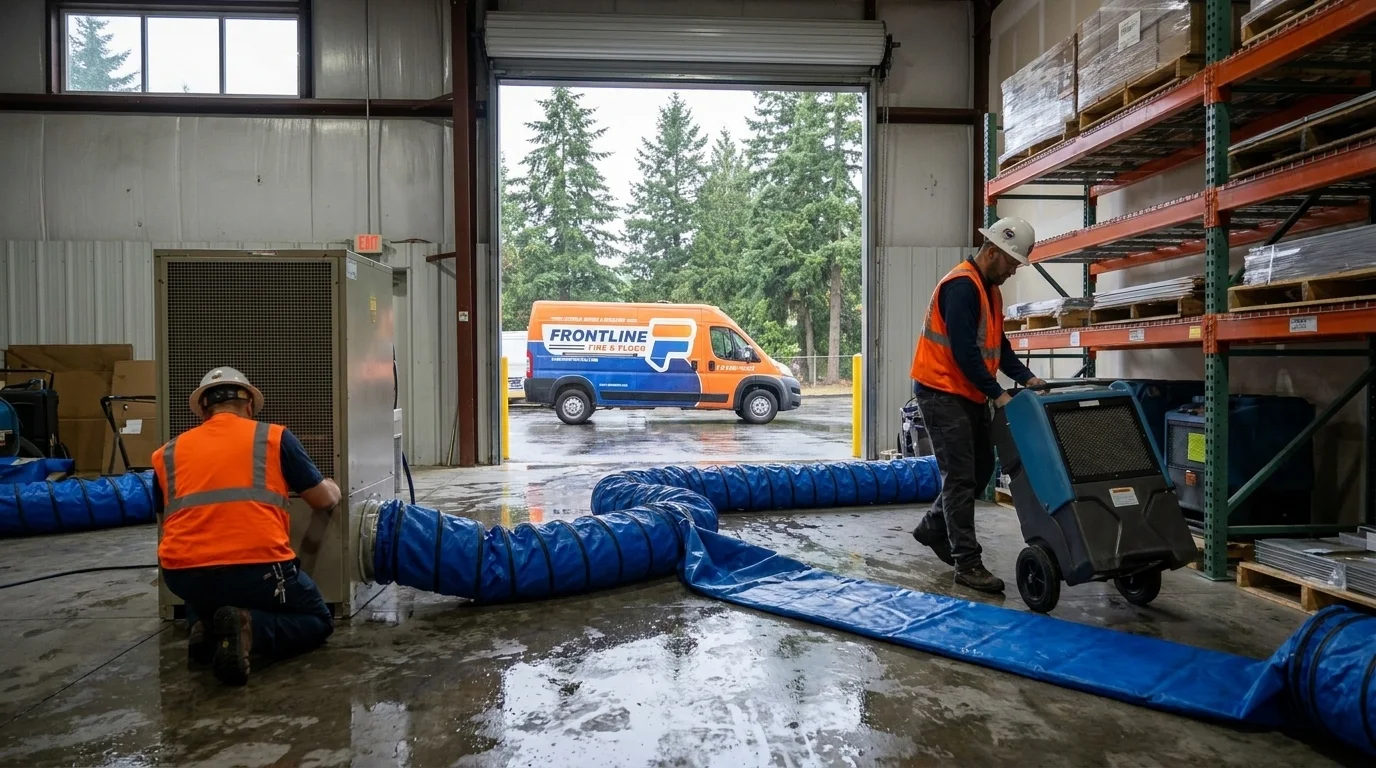
Industrial Restoration in Lakewood
24/7 industrial restoration in Lakewood and surrounding areas. IICRC-certified, insurance billing accepted. Call (253) 200-0503.
Industrial water or fire damage doesn’t just damage a building, it stops production. A burst supply line in a warehouse ceiling, a scorched electrical panel in a plant bay, or a sprinkler head that discharges onto a pallet of finished goods can shut down a line, trigger a business interruption clock, and put racking, machinery, and inventory at risk within hours. We answer 24/7 and bring the crew, extraction equipment, and documentation process built for facility-scale losses, not single-room jobs.
What industrial restoration actually involves
Industrial restoration covers the mitigation and recovery work specific to warehouses, manufacturing plants, distribution centers, and processing facilities, properties where the scale, the equipment on site, and the cost of downtime change how the job has to run. A 40,000 square foot warehouse with standing water under racking behaves differently than a flooded bedroom: the slab itself can hold moisture for weeks, HVAC systems distribute soot or humidity across the whole envelope, and machinery exposed to water or smoke residue can corrode or short out long after the visible cleanup is done. Work typically involves industrial-grade extraction units, desiccant dehumidification sized for large open volumes, moisture mapping of concrete and sub-slab areas, and coordination with your facilities or maintenance team so production can restart in sections rather than waiting on the whole building.
Our process
- Facility assessment and shutdown coordination. We walk the affected zones with your facilities manager or safety officer, identify utility shutoffs, hazardous materials, and equipment that needs isolating before any extraction begins.
- Large-volume extraction and residue removal. Truck-mounted and portable extraction equipment handles standing water across concrete, epoxy, or sealed flooring, while fire-related losses get soot and residue removal scoped to the surface type, drywall, steel, or exposed ductwork.
- Moisture mapping and machinery protection. Moisture meters and thermal imaging track water migration into slab, mezzanine framing, and wall cavities, and we flag equipment or electrical panels that need a licensed electrician’s clearance before power is restored.
- Structural drying at scale. Desiccant dehumidifiers and air movers are sized to the cubic footage of the space, not a single room, with daily moisture readings logged for the duration of the dry-out.
- Documentation and handoff. Photos, moisture logs, and a written scope go to your insurance carrier and property manager, so the business interruption and property damage portions of the claim have the paper trail adjusters expect.
What separates a good industrial restoration response from a bad one
The most common mistake on industrial losses is treating them like oversized residential jobs: a crew pulls visible water, runs a few fans, and calls it dry. Slab-on-grade concrete and sub-floor vapor barriers hold moisture far longer than drywall does, and if drying stops before the slab reads dry, mold and corrosion show up under racking or equipment pads weeks later. Another common miss is HVAC: a plant fire or heavy smoke event pulls soot into return air and distributes it through ductwork into areas that never saw visible flame, and skipping duct cleaning leaves an odor problem that resurfaces every time the system cycles. Adjusters on commercial and industrial claims also look closely at documentation of production downtime, so a restoration crew that logs moisture readings daily, photographs affected racking and inventory, and separates mitigation costs from reconstruction costs gives your claim a cleaner path than one that hands over a single invoice at the end.
What does industrial restoration cost?
Industrial losses vary more than almost any other restoration category because the cost depends on square footage, the number of production lines or equipment runs affected, and whether contamination reached electrical or mechanical systems. These are typical industry ranges, not a quote, every facility loss gets a written scope of work before any mitigation begins, and most commercial property policies cover sudden water and fire damage along with a portion of business interruption, though coverage specifics depend on your policy language.
| Scenario | Typical range |
|---|---|
| Small warehouse water intrusion, under 5,000 sq ft | $8,000 - $25,000 |
| Large warehouse flooding with racking and inventory affected | $25,000 - $75,000 |
| Manufacturing plant fire damage, single bay | $50,000 - $150,000 |
| Full facility smoke and soot remediation | $100,000+ |
| Machinery or equipment decontamination, per line | $2,000 - $10,000 |
Seasonal & regional considerations
Lakewood’s proximity to Puget Sound and the American Lake watershed means industrial sites on lower ground see elevated groundwater pressure during the wet season, which pushes moisture into slab joints and loading dock seams even without a visible leak. Older warehouse and light-industrial buildings around the JBLM corridor and South Tacoma often run unheated storage bays, where a hard freeze can crack an exposed supply line overnight and go unnoticed until a shift arrives to standing water. Facilities with rooftop HVAC or exposed ductwork are also worth a seasonal check before the first cold snap, since a frozen coil or cracked line above a production floor causes far more damage than the same failure in a conditioned office space.
Service area
We serve industrial and light-manufacturing properties throughout Lakewood and the surrounding South Puget Sound area, including Tacoma, Puyallup, University Place, and the JBLM corridor.
If water, fire, or smoke has reached your warehouse floor, production line, or storage racking, get a facility assessment started before the loss spreads to equipment or inventory you haven’t checked yet. Call (253) 200-0503 to begin an industrial restoration scope of work.
Frequently Asked Questions
Does commercial or industrial property insurance cover this kind of damage?
How long does structural drying take in a warehouse or plant compared to a house?
Can our facility keep operating in unaffected areas while restoration work is underway?
What happens to machinery and equipment that got wet or exposed to smoke?
Does smoke damage in one part of a plant affect the whole facility?
Looking for the best industrial-restoration company in Lakewood?
Frontline Fire & Flood provides licensed and insured industrial-restoration in Lakewood, WA and the surrounding area, and has served local property owners since 2014. Customers rate us 4.9 out of 5 stars across 137 Google reviews. We answer calls 24/7 — call (253) 200-0503 for immediate help.
Need industrial-restoration now?
We respond 24/7 across Lakewood and surrounding WA cities.
Related Coverage
- Our Restoration Services
- Contact Frontline Fire & Flood
- Restoration Services in Anderson Island
- Restoration Services in Auburn
- Restoration Services in Bonney Lake
- Restoration Services in Bremerton
- Restoration Services in Burien
- Restoration Services in Centralia
- Restoration Services in DuPont
- Restoration Services in Federal Way
- Restoration Services in Fife
- Restoration Services in Fircrest