
24/7 Emergency Ceiling Water Damage Repair in Lakewood
24/7 emergency ceiling water damage repair in Lakewood and surrounding areas. IICRC-certified, insurance billing accepted. Call (253) 200-0503.
Water coming through your ceiling in Lakewood? A brown ring spreading across drywall, a bulge that wasn’t there yesterday, or water actually dripping from a light fixture means saturated material is already failing above your head. We answer 24/7 at (253) 200-0503.
A ceiling that’s staining, sagging, or actively leaking is not a cosmetic problem you paint over and forget. Drywall loses most of its structural strength within hours of sustained saturation, and what looks like a coin-sized stain on the surface can mean a soaked insulation bay and wet framing above it. Waiting to see if it dries on its own usually means a bigger repair, not a smaller one.
What ceiling water damage repair actually involves
Most Lakewood homes built from the 1960s through the 1990s have standard drywall ceilings, but plenty of the older housing stock near Steilacoom and American Lake still has original plaster-and-lath ceilings, which behave differently under water than drywall and are more labor-intensive to patch correctly. Either way, the work starts above the visible stain, not at it. We use moisture meters and, where needed, a borescope to check what’s happening inside the ceiling cavity: insulation that’s wicked water across several feet, framing that’s begun to cup or swell, or a vapor barrier trapping moisture against the drywall’s backside. Sagging ceilings carry real weight once insulation and drywall are saturated, sometimes well over the material’s dry weight, so part of the initial visit is simply determining whether the ceiling is safe to stand under.
Our process
- Locate and stop the source. A leaking ceiling can trace back to roofing, a bathroom above, a supply line, an HVAC condensate line, or attic condensation. Repair doesn’t start until the source is shut off or isolated, otherwise we’re patching over an active problem.
- Contain and protect. We tarp roof penetrations if needed, set containment to catch ongoing drip, and protect flooring and contents below the affected area before any demolition starts.
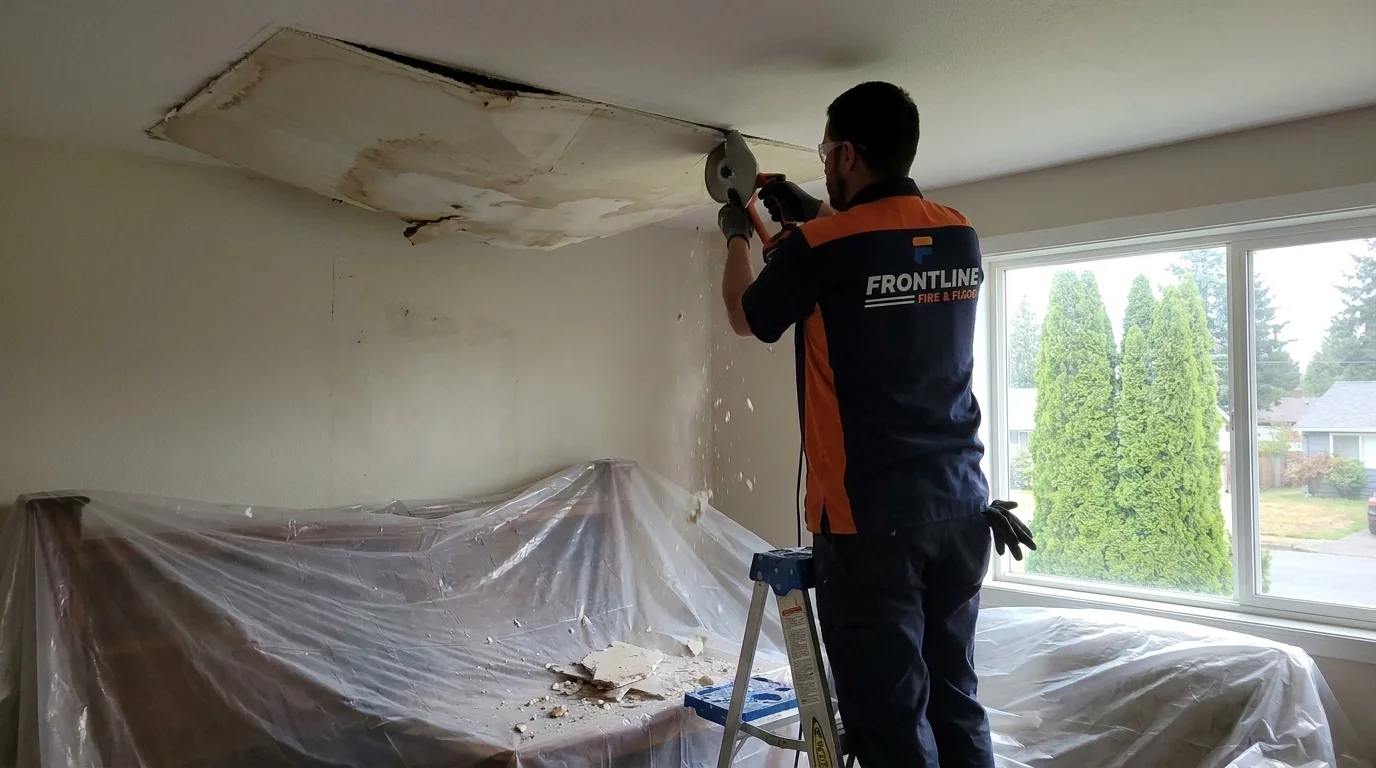
- Remove compromised material and dry the cavity. Saturated drywall, insulation, and texture are removed back to dry, sound material. Air movers and dehumidifiers go in to bring framing moisture content back to a dry standard before any rebuild begins.
- Rebuild and texture match. New drywall, insulation, and texture are matched to the existing ceiling finish so the repair doesn’t read as a patch once painted.
- Final moisture verification. We recheck framing and surrounding material with a moisture meter before closing the job, so nothing gets sealed in behind new drywall.
What separates a good ceiling repair response from a bad one
The most common mistake is patching the visible stain without checking how far moisture traveled laterally through insulation or along a top plate. A stain six inches wide on the ceiling can mean a wet patch three or four feet across in the attic above it. The second mistake is painting over a stain with a sealer-primer and calling it done when the source was never actually fixed, which just hides the next leak until it reappears somewhere else. Adjusters reviewing a ceiling claim generally want documented moisture readings, photos of the source before it was repaired, and a clear explanation of why the scope extends as far as it does, not just a before-and-after photo of the patched drywall. Electrical fixtures embedded in or near a wet ceiling are also a real hazard; OSHA-trained crews treat any fixture in the affected area as live until it’s confirmed otherwise.
What does ceiling water damage repair cost?
Costs vary with how far the water traveled, whether insulation and framing were affected, and whether the ceiling is drywall or older plaster. These are typical industry ranges, not a quote: every ceiling leak is different, and Frontline Fire & Flood provides a written scope of work before any repair begins.
| Scenario | Typical range |
|---|---|
| Small water stain, surface clean, paint only | $250 - $600 |
| Localized drywall cut-out and patch, single room | $600 - $1,800 |
| Sagging ceiling section with insulation replacement | $1,800 - $4,500 |
| Plaster ceiling repair, older home | $2,500 - $6,000 |
| Multi-room ceiling damage requiring structural drying | $4,500 - $12,000+ |
Homeowners insurance typically covers ceiling water damage when it results from a sudden, accidental event like a burst supply line or a storm-driven roof leak, but generally excludes damage tied to long-term neglect, like an unaddressed roof leak that’s been dripping for months.
Seasonal & regional considerations
Pierce County’s wet season runs heaviest from late fall through early spring, and most of the ceiling leak calls we see this time of year trace back to roofing that’s been fine for years suddenly failing under sustained rain, or ice buildup around poorly insulated attic penetrations during a cold snap. Homes with older or minimally ventilated attics can also develop condensation drip that mimics a roof leak but is actually a ventilation problem, which changes the repair approach entirely.
Service area
We repair ceiling water damage throughout Lakewood and nearby Pierce County communities, including University Place, Tacoma, Puyallup, DuPont, and the JBLM area.
If water is actively coming through your ceiling, shut off the source if you safely can and schedule your ceiling moisture assessment with Frontline Fire & Flood at (253) 200-0503.
Frequently Asked Questions
Does homeowners insurance cover ceiling water damage repair?
How do you find where a ceiling leak is actually coming from?
My ceiling is sagging but hasn't collapsed. Is it still an emergency?
Will you have to cut out my whole ceiling or just the damaged section?
How long does drying take before you can rebuild the ceiling?
Looking for the best ceiling-water-damage-repair company in Lakewood?
Frontline Fire & Flood provides licensed and insured ceiling-water-damage-repair in Lakewood, WA and the surrounding area, and has served local property owners since 2014. Customers rate us 4.9 out of 5 stars across 137 Google reviews. We answer calls 24/7 — call (253) 200-0503 for immediate help.
Need ceiling-water-damage-repair now?
We respond 24/7 across Lakewood and surrounding WA cities.
Related Coverage
- Our Restoration Services
- Contact Frontline Fire & Flood
- Restoration Services in Anderson Island
- Restoration Services in Auburn
- Restoration Services in Bonney Lake
- Restoration Services in Bremerton
- Restoration Services in Burien
- Restoration Services in Centralia
- Restoration Services in DuPont
- Restoration Services in Federal Way
- Restoration Services in Fife
- Restoration Services in Fircrest