
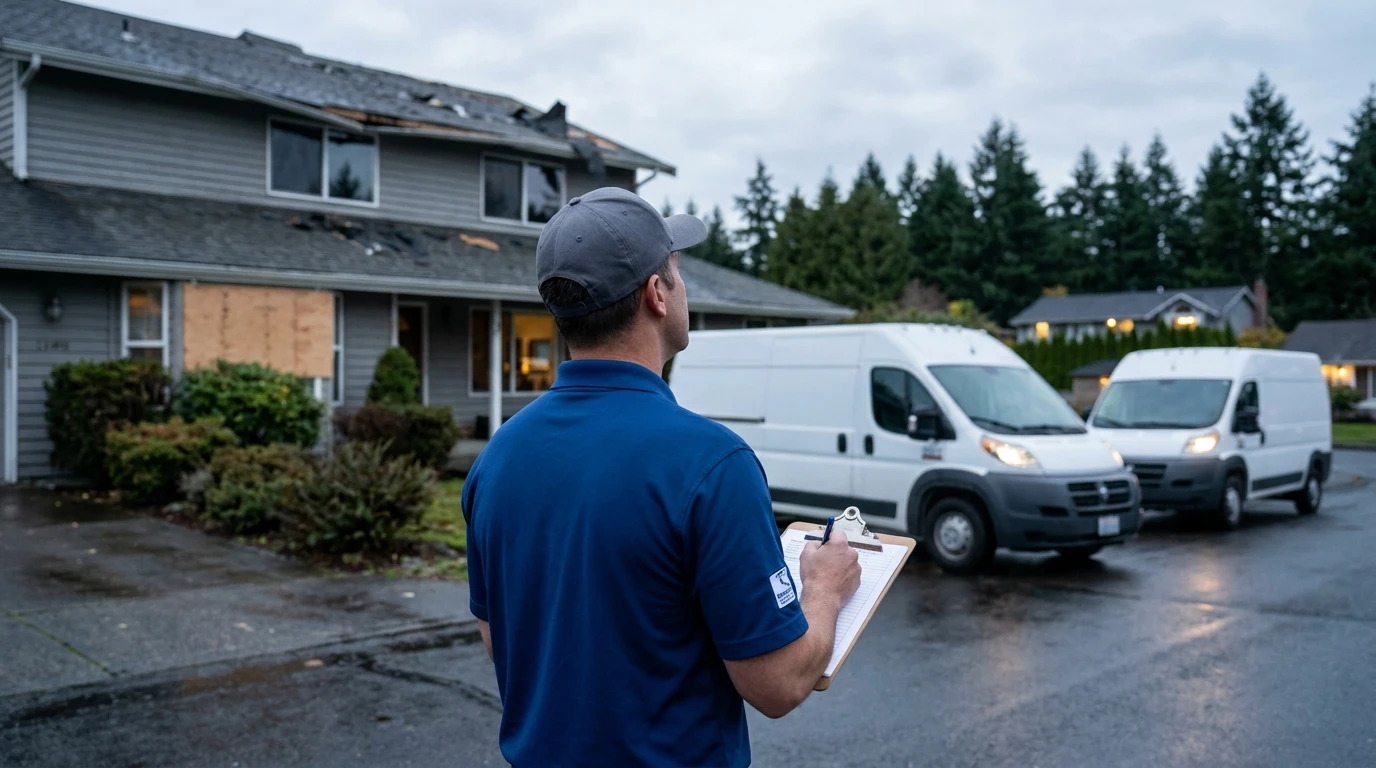
TL;DR: The right storm damage restoration company in Tacoma can prove four things: a current Washington contractor license, IICRC water and structural-drying certification, insurance-claim documentation experience, and same-day tarping or board-up. A roofer alone covers the shingles, not the ceiling drip or the wet drywall underneath. Verify the license through Washington’s L&I lookup tool, ask for the IICRC certificate number, and get a written scope before anyone starts work.
If a windstorm off Puget Sound just peeled shingles loose over your Tacoma living room and water is already dripping through the ceiling, you don’t have time to read ten review sites. You need a way to tell, in the next few minutes, whether the company on the phone can actually stop the water and document the loss correctly, or whether they only patch roofs. This guide gives you that checklist.
What does a storm damage restoration company actually do differently than a roofer?
A storm damage restoration company stabilizes the building and dries it out; a roofer replaces the roof covering. Those are two different trades, and a storm claim usually needs both, often in a specific order.
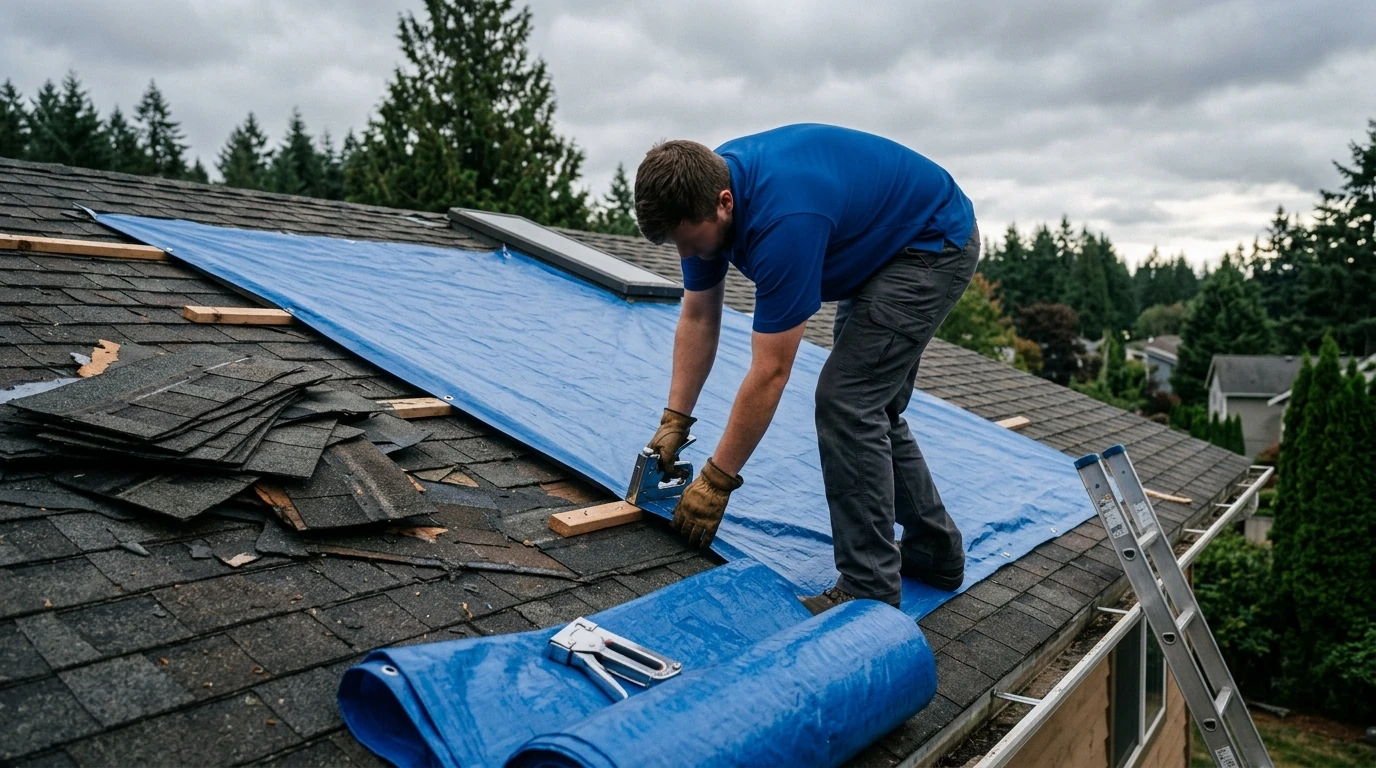
When wind or hail breaches a roof or siding, the first priority is stopping ongoing water intrusion: tarping the opening, extracting standing water, and starting structural drying before mold has a chance to start (mold can begin growing on wet materials within 24 to 48 hours, per the EPA). That’s mitigation work, governed by the ANSI/IICRC S500 water damage standard. Only after the structure is stabilized does the permanent roof repair happen, which is roofing trade work.
Some roofing contractors advertise “storm damage restoration” but only handle the shingles. If a company can’t describe how they’ll dry out a soaked attic or document the interior loss for your adjuster, they’re a roofer, not a restoration company. Frontline Fire & Flood handles both the emergency board-up/tarp and the interior water mitigation, and coordinates the rebuild from there.
What should you check before hiring a storm damage company in Tacoma?
Check four things: the Washington contractor license, IICRC certification, how they document for insurance, and how fast they can actually get a tarp on the property. Anyone can claim all four on a phone call; only some can prove it.
- License status. Washington requires a registered contractor license for this work. You can verify any company’s license status directly through the Washington State Department of Labor & Industries contractor lookup. Frontline Fire & Flood is licensed under CCFRONTFF761CB; look up any company before they set foot on your property.
- IICRC certification. The Institute of Inspection, Cleaning and Restoration Certification trains and certifies technicians in water damage (WRT), structural drying (ASD), and fire/smoke restoration (FSRT). These aren’t marketing badges; they’re the standards an insurance adjuster will expect the work to follow.
- Insurance documentation. Storm claims live or die on documentation: moisture readings, photos before tarping, a written scope of work. A company that skips this step is making your claim harder to win.
- Actual response capability. “24/7” only means something if the company’s hours actually say so. Ask directly: who shows up, how fast, and what do they do first.
What questions should you ask a storm damage contractor before signing anything?
Ask these four before you sign a work authorization: are you licensed in Washington, are you IICRC certified, will you provide a written scope before billing, and will you document the loss for my insurance company. A company that hedges on any of these is worth a second call.
Other questions worth asking on that first phone call: What water category are we dealing with? (Wind-driven rain and water that’s come in from outside the envelope is often treated as more contaminated than a simple roof drip, which starts clean but degrades the longer it sits, per the IICRC S500 standard.) Will you tarp or board up today, or just give me an estimate? Do you subcontract the drying work, or is it your own crew? What’s included in a written scope versus a verbal estimate?
If the person on the phone can’t answer the IICRC or licensing question without checking, that’s useful information too.
Will homeowners insurance cover storm damage repair?
Most homeowners policies cover sudden, wind-related storm damage, like a tree limb through the roof or shingles torn off in a windstorm, but they draw a hard line at flood water. Check your specific policy, since coverage details vary by insurer.
Flood damage, meaning rising surface water from outside the home, typically requires a separate flood policy and isn’t covered under a standard homeowners policy, per the Insurance Information Institute. Wind and rain intrusion through a storm-damaged roof is usually treated differently than groundwater flooding, so it matters which one actually happened at your property. If you have questions about your specific policy language, the Washington Office of the Insurance Commissioner is the state resource for homeowner insurance questions. Our water damage restoration page covers how category and class of loss affect what gets dried versus removed, which is worth reading before you talk to your adjuster.
What happens when you call Frontline Fire & Flood after a storm in Tacoma?
A same-day visit starts with stopping the water: tarping the roof or boarding broken windows, then moving to extraction and drying if water has already gotten inside. From there, the crew documents everything for your insurance claim before any permanent repair begins.
Frontline Fire & Flood has worked storm calls across Tacoma and the South Sound since 2014, holds an IICRC Certified Firm designation, and operates on a 24/7 basis. The company carries a 4.9 average from 137 Google reviews at the time of writing. Emergency board-up and tarping is the first call when a storm has opened up the structure; if water has already made it inside, that work runs alongside interior drying so the claim timeline doesn’t stall. Our storm and wind damage guide walks through what to document in the first hour after the wind dies down.
Use the checklist above on any company you’re considering, Frontline Fire & Flood included. A company that can answer every question directly, with a license number and certification you can verify yourself, is the one worth having on the roof.
About Frontline Fire & Flood
Frontline Fire & Flood is an IICRC Certified Firm serving Tacoma, Lakewood, and the South Sound since 2014 (Washington license CCFRONTFF761CB). The company’s technicians hold IICRC certifications in water damage (WRT), structural drying (ASD), and fire and smoke restoration (FSRT), and the crew operates on a 24/7 basis. Frontline’s service lines cover storm and wind damage restoration, emergency board-up and tarping, water damage restoration, fire and smoke restoration, mold remediation, and sewage cleanup across the Tacoma and Lakewood area. Call Frontline Fire & Flood at (253) 200-0503 to schedule a storm damage assessment.
Video Transcript
A sudden windstorm just tore shingles off your Tacoma roof, and now water is dripping through your ceiling. Here’s the key difference: a roofer only replaces your roof covering, but a true storm restoration company stops the water and dries out your entire home. According to the EPA, mold can start growing on wet materials within just 24 to 48 hours, so tarping, extraction, and structural drying must happen fast. Before you hire anyone, check their Washington contractor license through the L&I lookup tool, right from your phone. Always ask for their IICRC certification number, it proves they follow the exact water-damage standards your insurance adjuster will expect to see. A trustworthy contractor documents everything: moisture readings, photos before tarping, and a written scope before any work begins. Ask directly who shows up today, how fast they’ll respond, and whether they’ll tarp or board up immediately. Make sure the company handles both the emergency mitigation and the full rebuild, so you’re not juggling separate roofers, drying crews, and contractors. Most homeowners policies cover sudden wind damage, but flood water usually needs separate coverage, so double-check your policy. Frontline Fire & Flood is licensed, IICRC certified, and ready to document your claim correctly, call (253) 200-0503 for a free estimate.